Biography
Ada Lovelace
"That Enchantress who has thrown her magical spell around the most abstract of Sciences and has grasped it with a force which few masculine intellects could have exerted over it."
— Charles Babbage
Early Life
Augusta Ada King, Countess of Lovelace — better known as “Ada Lovelace” — was born on December 10, 1815. Her mother was Anne Isabella Milbanke, the only child of Sir Ralph Milbanke, 6th Baronet, and his wife, the Hon. Judith Noel. Her father was the infamous English romantic poet, George Gordon Byron, 6th Baron Byron.
Ada’s mother, mathematically educated herself, left her husband, Lord Byron, five weeks after Ada was born, and returned to live with her parents at Kirkby Hall in Kirkby Mallory, Leicestershire, which is 5 miles outside the market town of Hinckley. Ada never saw her father again. (The phrase "mad, bad, and dangerous to know" was coined by Lady Caroline Lamb in 1812 to describe her former lover, the increasingly scandalous Lord Byron.)
Childhood
Ada’s mother was a champion of prison reform and the abolition of slavery. Her reformist work meant she spent little time at Kirkby Mallory, leaving Ada in her grandmother’s care. Her grandmother managed the family estates, which stretched across the Midlands to Dudley. As a consequence, she made frequent visits to the bank in Hinckley and usually took Ada with her. Ada's experiences in Hinckley at a young age are well documented in the diary of Miss Lamont who was an early governess to Ada. This diary now forms part of the Lovelace Papers at the Bodleian Library in Oxford. Ada was enchanted by the town. To be denied a visit to Hinckley was Ada's worst punishment if she had been disobedient.
Ada lived at Kirkby Hall until age 6, when in 1822, her Grandmother passed away. Kirkby Mallory Hall was demolished in 1952, but the substantial stable block remains and has been repurposed. A blue plaque commemorates Ada’s life there.
After her grandmother’s death, Ada’s Mother moved back to London, living at various addresses, during which time, Ada was tutored privately.
Contribution to Early Computing
Encouraged by her mother, who didn't want her daughter following in her father's footsteps, Ada showed an exceptional mathematical ability from a very young age. In 1821, Miss Lamont wrote of her 5-year old charge: "She adds up sums of five or six rows of figures, with accuracy; she is deliberate and correct in the process, and takes an interest in the performance."
In 1833, Ada was introduced by her tutor, Mary Somerville, a leading scientist and mathematician in her own right, to Charles Babbage.
Babbage was the creator of a calculating machine, the Difference Engine, intended to calculate and print logarithm tables error-free. The machine fascinated Ada, resulting in a lifelong working relationship with Babbage.
In 1837 Babbage designed a second machine, naming it the “Analytical Engine”. It comprised the components of the electronic computer today, but in mechanical form.
After attending a lecture Babbage gave on the Analytical Engine to a group of Italian scientists in Turin in 1840, a mathematician named Luigi Menabrea wrote an article on the machine's potential. Ada, fluent in French, was given the task of translating and expanding this article by Babbage.
While translating the text, Ada added her own explanatory notes, extending the original work in length by a factor of three, and including several of her own "computer programmes". Note G, an algorithm designed to calculate Bernoulli numbers, is the best known of these supplemental notes, and is considered so accomplished it is widely regarded as the very first computer “programme”.
The article, "Sketch of the Analytical Engine, with Notes from the Translator" by Ada Lovelace (translating Luigi Menabrea), was published in 1843 in Volume 3 of Taylor's Scientific Memoirs. The groundbreaking work, which included what many consider to be the first published computer program, was released in London by Richard and John E. Taylor.
Ada envisioned the Analytical Engine had the capability to calculate values other than numbers, and surmised it might compose music and write poetry, thus foreseeing the possibilities of computerisation.
The engines Babbage designed were never built during their lifetimes, their work was almost entirely theoretical other than small sample proof-of-concept engines.
Life and Death
Ada married Sir William King in 1835, becoming the Countess of Lovelace in 1838 when her husband was elevated to the Earldom of Lovelace. They had three children: Byron, Anne Isabella, and Ralph Gordon.
Following a long and painful illness, Ada died from uterine cancer on 27 November, 1852 in Marylebone, London. She was just 36. She was buried, at her request, next to her father at the Church of St Mary Magdalene in Hucknall, Nottinghamshire.
After her death, her mother commissioned a large memorial to be built at the Parish Church in Kirkby Mallory, where Ada has been christened. Standing on the perimeter of the church graveyard, the memorial was renovated by English Heritage at a cost of more than £35,000 in the 1990s.
Legacy
In the 1930s, Alan Turing referred to Ada’s work when developing the first electronic computer to crack the German Enigma code at speed.
In the 70s, the United States Department of Defence developed one of the first high-level computer language and named it in honour of Ada. The Military Standard reference manual was approved on December 10, 1980 (the anniversary of Ada’s birthday), and given the number MIL-STD-1815 in honour of Ada's birth year in recognition of her work and vision.
Only in the 1980s was a working version of Babbage’s Difference Engine built. The Science Museum in Kensington used Babbage’s original design drawings, which had been donated many decades earlier. Their working Difference Engine No. 2, first displayed in 1991 and completed in 2002, functioned exactly as intended without modification, and stands at the entrance to the museum’s Mathematics and Computing Gallery today.
Ada’s legacy has since been increasingly recognised, culminating in the annual Ada Lovelace Day (held each year on the second Tuesday in October). Launched in 2009, it is devoted to her memory and is an international celebration of the achievements of women in science, technology, engineering and maths (STEM).
Remembering Ada
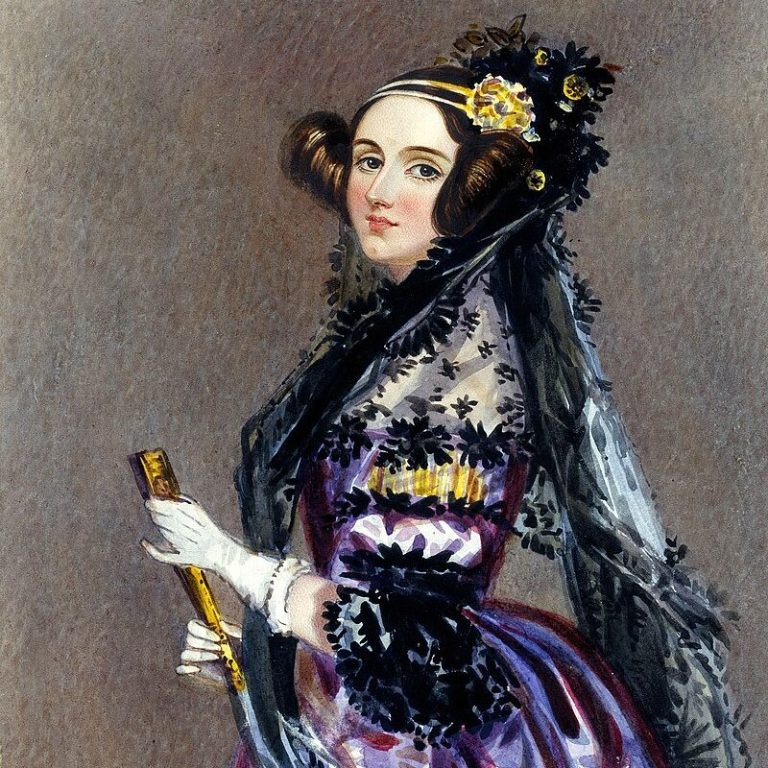
On January 31, 2026, a statue of Ada Lovelace was unveiled in her beloved Hinckley. The statue was inspired by the famous Margaret Sarah Carpenter portrait of Ada (see above), which hung in No. 10 Downing Street until recently. The celebrated painting is part of the Government Art Collection and is now on display at the National Portrait Gallery.
A full-size reproduction of this painting was created for a temporary exhibition in October 2019 celebrating Ada's life and legacy. The exhibition was held in the gallery of the Atkins Building in Hinckley, and was the most successful exhibition ever held in the town. This reproduction painting now hangs in the foyer of the Hinckley Campus of the North Warwickshire and South Leicestershire College, which is next door to the Atkins Building.
The success of the 2019 exhibition, prompted the team behind it — local historian Greg Drozdz and former councillor Stan Rooney, who had been appointed to the role of “Heritage Champion” in 2015 — to start a grassroots campaign to create a permanent memorial to Ada in the town. After conducting various feasibility studies in 2023, the duo launched a fundraising campaign in February 2024 at a reception held in Atkins Building. The statue is the culmination of over 7 years' work by Stan, Greg, and the team of supporters they assembled under the umbrella of the Ada Lovelace in Hinckley Community Interest Company.
The life-size and a half statue of Ada was created by artists Etienne and Mary Millner. The bronze statue is 2.5 meters tall, weighs half a metric tonne, and is mounted on a round Portland stone plinth 0.5 metres high. North Warwickshire and South Leicestershire College Estates Manager, Jonathan Howard, supported the project, ensuring Ada has a home in front of the Hinckley Campus in perpetuity.